
Northern lights in the Faroe Islands, and how to reach them without a car
The short answer
Yes, the aurora is seen from the Faroe Islands — the islands sit at 62°N and the dark season runs from late August to April. But two things are true that most guides leave out.
First, October has historically been the strongest month, not December. Over 30 years of measured geomagnetic data, 9.2% of October nights reached storm level while the sky was genuinely dark, against just 3.5% in December — even though December has the most darkness of any month.
Second, and this is the part that decides your trip: almost every viewing spot the tourist board recommends is somewhere you cannot get back from at night without a car. The rural routes that serve them are weekday-only, request-only, or finish long before the sky is dark. If you are travelling without a car, the answer is to sleep where you watch.

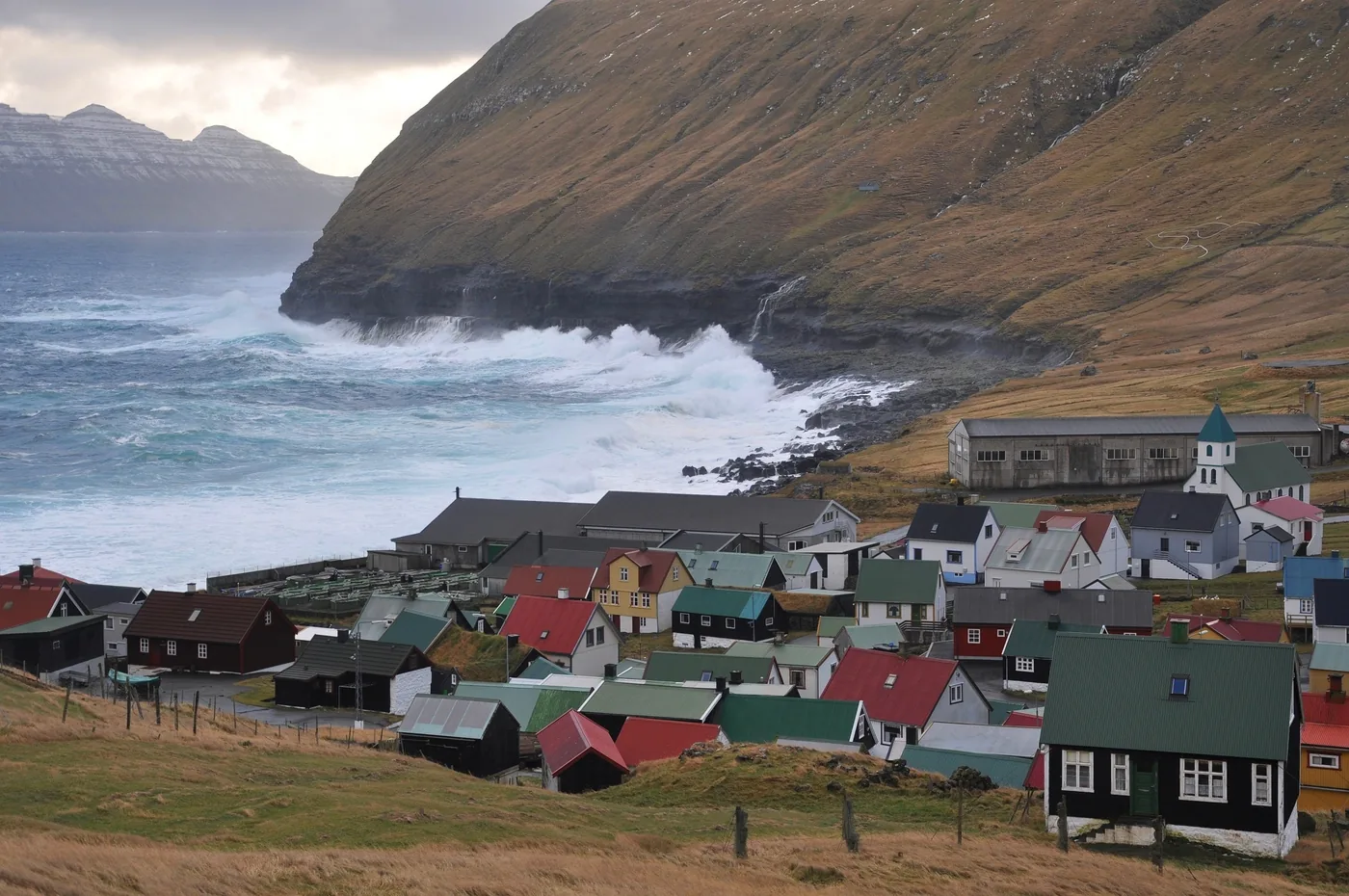
Shot over Vestmanna — the one village on the viewing list that route 100 reaches direct from Tórshavn.
Measured, not predicted
Which months actually delivered
Every figure below comes from the official Kp index — the standard measure of geomagnetic activity — filtered to the three-hour windows when the sun was more than 12° below the horizon at Tórshavn. A month scores when at least one dark window that night reached the level shown.
Nights reaching storm level (Kp 5+) Hours of darkness per night × no darkness at this latitude
Column chart of twelve months. Storm-level nights peak in October at 9.2 percent and fall to 3.2 percent in August. May, June and July have no astronomical darkness and are marked as not possible. Hours of darkness per night are shown behind, peaking in December.
Show these figures as a table
| Month | Nights reaching storm level (Kp 5+) | Hours of darkness per night |
|---|---|---|
| Jan | 4.8% | 13.7 h |
| Feb | 5.9% | 12 h |
| Mar | 7% | 8.5 h |
| Apr | 4.9% | 5.3 h |
| May | — | — |
| Jun | — | — |
| Jul | — | — |
| Aug | 3.2% | 4.7 h |
| Sep | 7.8% | 7 h |
| Oct | 9.2% | 11.8 h |
| Nov | 6.3% | 12 h |
| Dec | 3.5% | 14.4 h |
Why the equinoxes win
The pattern in that chart is not noise. Geomagnetic activity genuinely peaks around the March and September equinoxes, when the Earth's magnetic field is tilted so that it couples most efficiently with the solar wind. That is why October, September and March sit at the top, and why the deep midwinter months sit lower despite their long nights.
The practical reading: late September through October, and March, buy you strong activity and enough darkness at the same time. They are also shoulder season, when accommodation is easier and the buses are still running a fuller timetable than in deep winter.
What these numbers do not tell you
- They are not a forecast. These are measurements of past nights, not a prediction. Space weather cannot be forecast months ahead, and a month that has been good historically can be quiet.
- Cloud is not included. Cloud is not included in these figures. A clear sky is required and the Faroe Islands are frequently overcast, so the share of nights on which you would actually have SEEN an aurora is lower than every number here.
- The solar cycle moves. Geomagnetic activity rises and falls on a roughly eleven-year solar cycle, so the level in any given winter can sit well above or below this long-run average.
See the complete record, month by month — all three activity levels, the count of nights behind every percentage, and what the bus network is doing in each part of the season.
GFZ Helmholtz Centre for GeosciencesGeomagnetic Kp index, Geomagnetic Observatory Niemegk
Matzka, J., Stolle, C., Yamazaki, Y., Bronkalla, O. and Morschhauser, A., 2021. The geomagnetic Kp index and derived indices of geomagnetic activity. Space Weather, 19, e2020SW002641. https://doi.org/10.1029/2020SW002641
The part nobody else answers
Every viewing spot, and whether you can reach it without a car
These are the places Visit Faroe Islands recommends in its own northern lights guide. The transport verdict beside each one comes from our route pages, not from the aurora guide — and it is allowed to say no.
-
Velbastaður and the Oyggjarvegur ridge
Hard without a carThe closest genuinely dark ground to Tórshavn, on the old mountain road above the town.
No scheduled bus serves the ridge after dark. It is reachable on foot from Tórshavn in daylight, but that is a long walk back in winter weather and unlit.
-
Vestmanna
Hard without a carRoute 100 direct from Tórshavn along the west coast of Streymoy.
One of the better-served villages on this list, but the last bus still leaves well before a winter night is properly dark. Check the return on our route page before counting on it.
-
Sandoy
Hard without a carRoute 650 from Tórshavn runs through the Sandoyartunnilin to Sandur.
The tunnel put Sandoy within a bus ride of the capital, which makes it the most realistic dark-sky island to reach without a car — provided you are staying, not returning.
-
Suðuroy
Workable without a carThe two-hour ferry from Tórshavn, then route 700 along the island.
The southernmost island, far from the capital's light, and the one place on this list where the transport actually suits the plan: you were always going to stay the night.
The version of this for people without a car — eight places to sleep compared on how you reach them and whether the darkness is walkable once you are there.
Visit Faroe IslandsNorthern Lights Guide
Experiences
If the last bus has gone
Most of the places above cannot be reached and returned from in a night on scheduled transport. A guided trip is the usual way round that, and it is the honest option to put here.
Some links on this page are affiliate links. If you book through one we may earn a commission, at no extra cost to you. It never changes what we tell you about the buses and ferries, and no operator pays for a place on this site.
Next
Keep planning
Visit Faroe IslandsNorthern Lights GuideGFZ Helmholtz Centre for GeosciencesGeomagnetic Kp index, Geomagnetic Observatory NiemegkVisit Faroe IslandsNorthern Lights GuideStrandfaraskip LandsinsRoute 400 Klaksvík – TórshavnRoute 202 Oyrarbakki – TjørnuvíkRoute 201 Oyrarbakki – GjógvRoute 300 Tórshavn – Airport – SørvágurRoute 350 Tórshavn – Vága Airport – Sørvágur/BøRoute 500 Klaksvík – ViðareiðiRoute 100 Tórshavn – VestmannaRoute 650 Sandoy – TórshavnFerry route 7 Suðuroy – TórshavnRoute 700 Sumba – Vágur – Tvøroyri